 NOAA's National Centers for Environmental Information

 January Temperature Anomalies |
January 2006 While North America experienced an unusually mild January, much of Asia endured harsh winter conditions. Additional information can be found below. |

Across the United States, significant drought amelioration continued throughout the Northwest and Rocky Mountains, while worsening drought conditions were observed in the Southern Plains and Southwest. Exceptional drought classification persisted in the Arklatex region during early January, where grassfires were also a major problem early in the month. |
 U.S. Drought Monitor |
For comprehensive drought analysis, see the U.S. drought report. For information on wildfires in the U.S. Southern Plains during January, see the January 2006 wildfire season summary page. |
 African Weather Assessment |
Severe drought continued in eastern Ethiopia, southern Somalia, portions of Tanzania, as well as northern and eastern Kenya. The president of Kenya declared a state of national disaster in areas affected by severe shortages of food and water resulting from the prolonged drought (IRIN). In Burundi, at least $75 million (USD) of the Burundian government's $168 million (USD) emergency funds for 2006 was earmarked to feed the country's drought-affected population (IRIN). An estimated 11 million people were faced with food shortages throughout East Africa and the Horn of Africa due to drought and other non-meteorological factors (IFRC). For the latest African analysis and forecast, see the Famine Early Warning System Network. |
Strong winds and high temperatures fanned bushfires in southern Australia on the 26th. One large fire in the Grampians National Park in the state of Victoria burned more than 120,00 hectares (300,000 acres), destroyed 24 homes and killed 59,000 sheep. Wildfires in Victoria killed three people this month (Reuters). Very warm weather, concentrated in the eastern part of Australia, contributed to the sixth-warmest January on record for the country as a whole (Australian Bureau of Meteorology). |
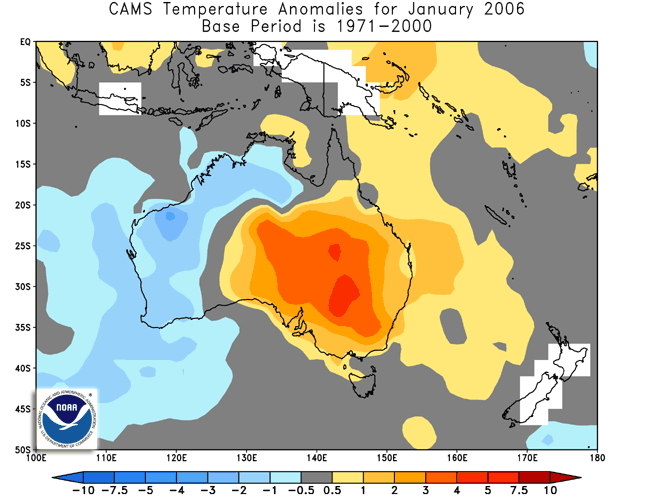 Australia Temperature Anomalies |


Across Indonesia, heavy rains in mountainous central Java on the 4th produced a deadly mudslide in the village of Cijeruk. The slide buried 120 houses, with around 200 people feared dead (AFP). Along the north coast of Java by late-month, flooding and landslides claimed at least 7 additional lives (AFP). |
Heavy seasonal rainfall in Africa brought flooding to parts of southern Malawi, Namibia, northern Botswana, southern Angola, southern Mozambique and northern areas of South Africa during January 2006. In southern Malawi, nearly 1,800 dwellings and over 24,000 hectares (59,000 acres) of crops were destroyed by flooding since the beginning of December 2005 (IFRC). |
In Bolivia, heavy rainfall produced flooding along most of the major rivers in the country, including the Rio Grande, Guanay, Tipuani, Mapiri and Challana. Approximately 17,500 people were affected. Landslides and road obstructions caused some rural communities to be isolated, especially in the areas of Los Yungas and San Borja in La Paz and Beni departments (OCHA). |
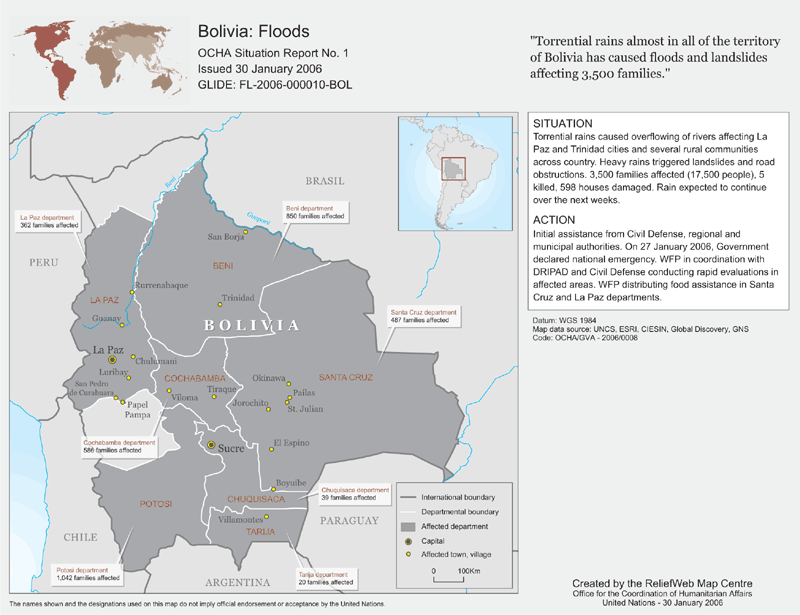 Flooding In Bolivia |
In Brazil, flash flooding caused by heavy rains killed 4 people in Rio De Janeiro on the 27th. The fatalities occurred when a shopping mall parking garage became flooded (Associated Press). |
 Flooding In Guyana |
Heavy rains since December 2005 in Guyana caused flooding, especially along coastal areas of the country. An estimated 3,500 families were affected, including significant agricultural impacts (OCHA). |

In the United States, an outbreak of severe thunderstorms affected areas of the Ohio Valley into the Southeast on the 2nd. Hail, damaging thunderstorm winds, and several tornadoes were reported, with most of the adverse weather occurring in the states of Kentucky and Georgia. |
 U.S. Severe Weather |

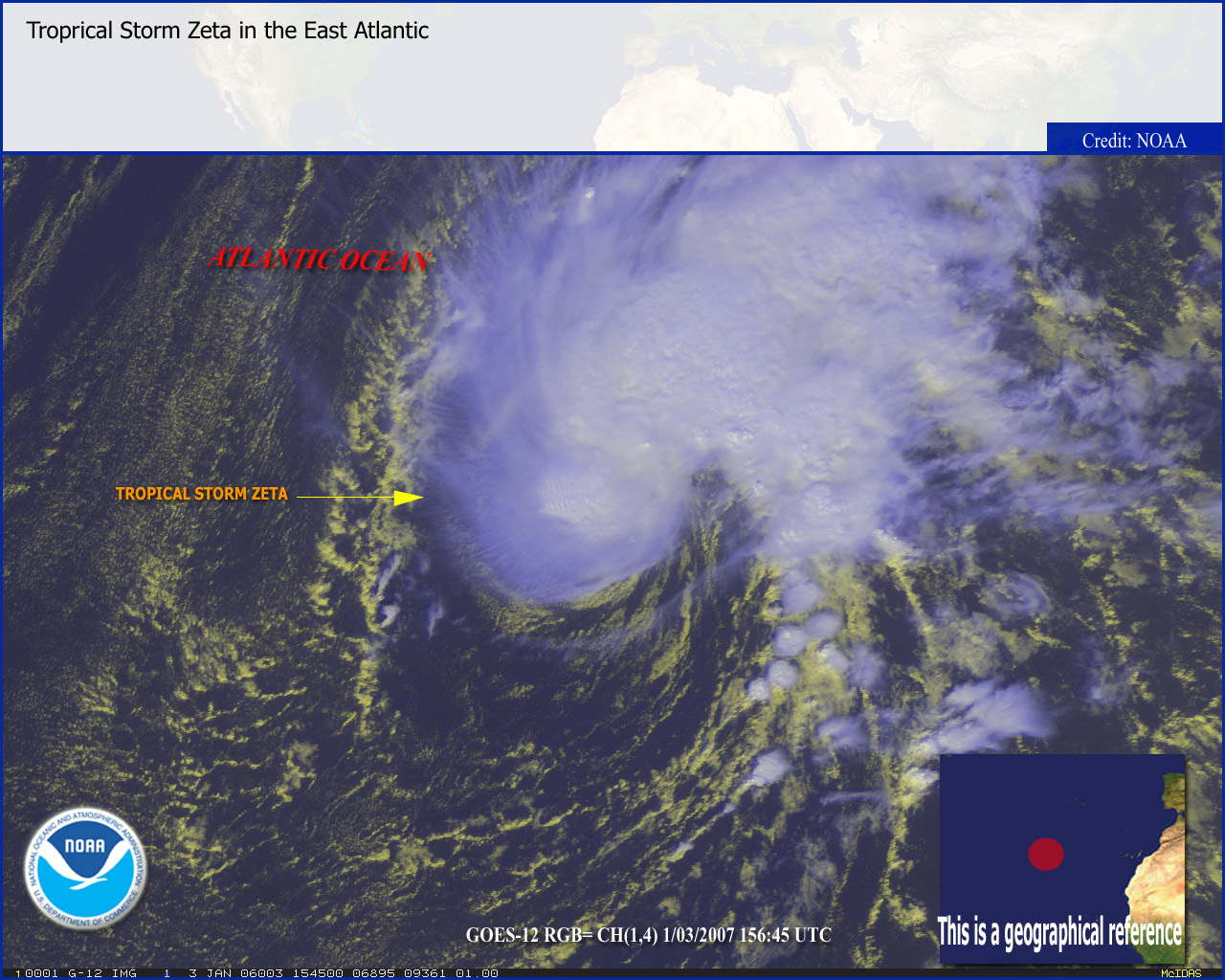 Tropical Storm Zeta |
Tropical Storm Zeta, which developed at the end of December 2005, weakened below tropical storm strength by January 6th without affecting land areas. Zeta closed out the 2005 Atlantic Hurricane Season as the unprecedented 27th named storm. |

Tropical Cyclone Clare developed in the Indian Ocean off the northwest coast of Western Australia on the 8th. The storm made landfall in Western Australia on the 9th near Dampier, or about 1200 km (750 miles) north of the state capital of Perth. Maximum sustained winds were near 110 km/hr (60 knots or 70 mph), with gusts as high as 185 km/hr (115 mph). Up to 1,500 people were evacuated from the area ahead of the cyclone (Reuters). |
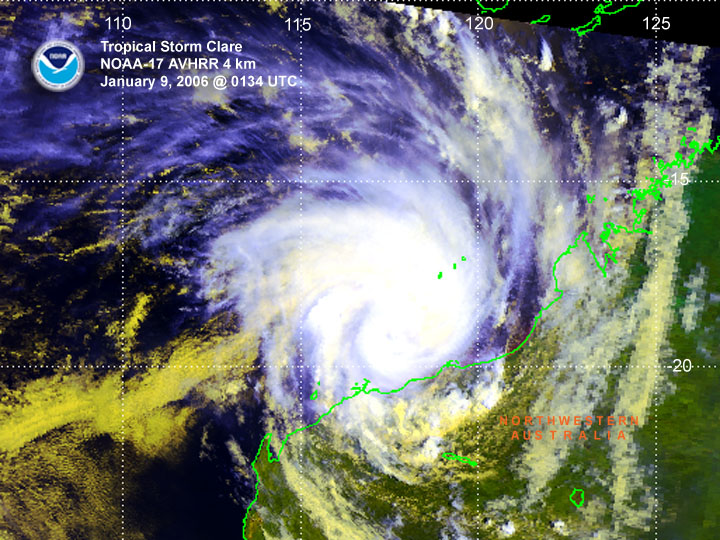 Tropical Cyclone Clare |

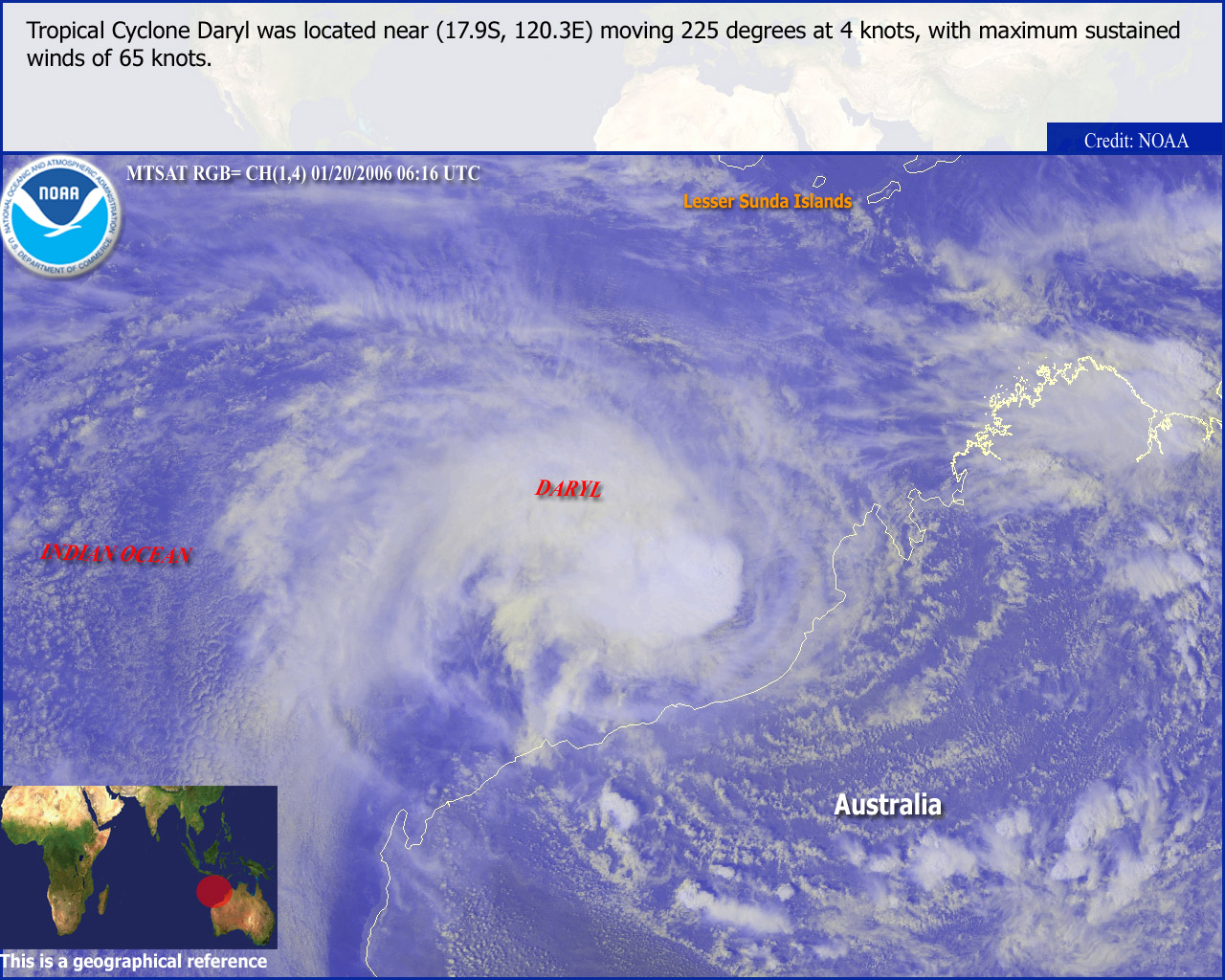 Tropical Cyclone Daryl |
Tropical Cyclone Daryl developed in the Indian Ocean off the northwest coast of Western Australia on the 19th. Daryl paralleled the coastline without ever making landfall in Australia, although coastal areas did receive significant amounts of rainfall. The cyclone dissipated on the 22nd. |

Tropical Cyclone Boloetse formed in the southern Indian Ocean on the 25th, crossing Madagascar during the 29th-30th. The primary impact across Madagascar was heavy rainfall, with satellite rainfall estimates exceeding 150 mm (5.9 inches) in northern and central portions of the country. The storm emerged into the Mozambique Channel by month's end. |
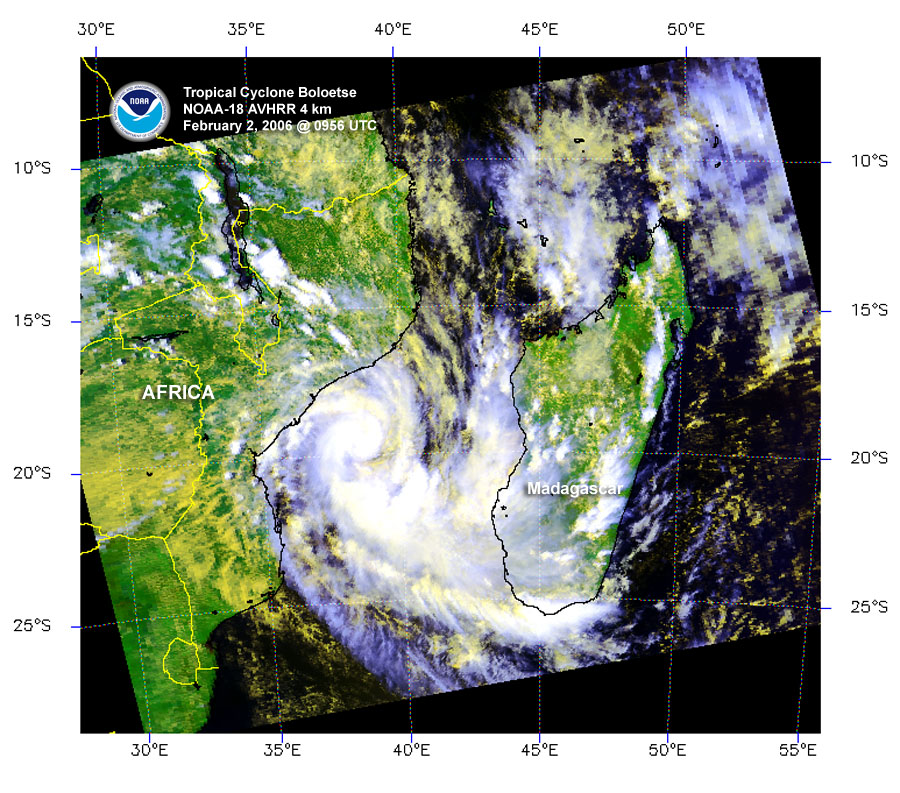 Tropical Cyclone Boloetse |

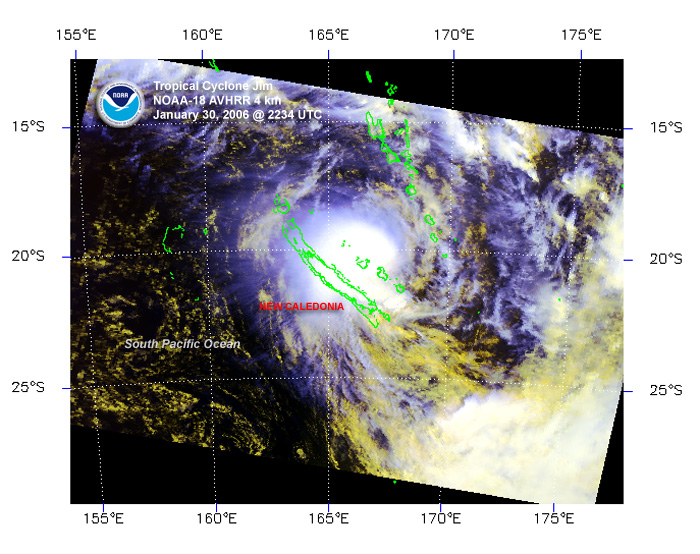 Tropical Cyclone Jim |
Tropical Cyclone Jim developed in the South Pacific Ocean off the coast of northeast Australia (Queensland) on the 28th. Jim passed just north of New Caledonia on the 30th-31st, brushing the islands with strong winds and heavy rainfall. |

For 2006 basin tropical cyclone statistics, please refer to the
following:
|

In the United States on the 18th, a powerful extratropical storm system brought heavy rains and strong winds to the Mid-Atlantic and Northeast states, with heavy snow across interior sections. Strong winds gusted to near 100 km/hr (60 mph) in the Boston and New York City metropolitan areas, causing significant travel disruptions and knocking out power to more than 440,000 homes and businesses in the region. The strong winds were blamed for two deaths (Associated Press). |
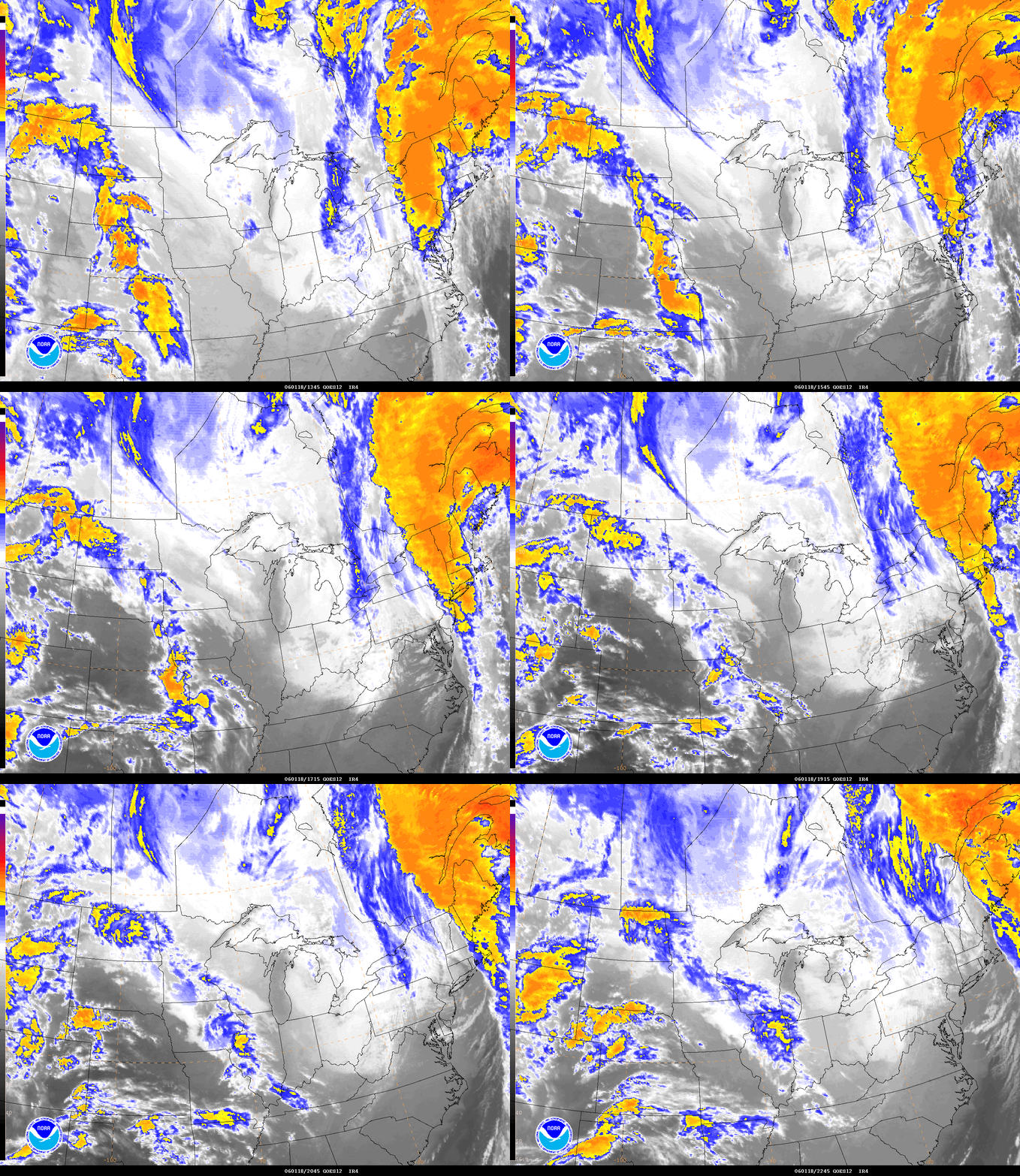 Satellite Animation (large ~8MB file) |

 Asia/Europe Snow Cover |
Periods of heavy snowfall that began in Japan during the month of December 2005 persisted into mid-January. Areas of the country were buried under some of the deepest drifts on record (~4 meters or 13 feet), with 82 fatalities since the period of severe winter weather began. Injuries relating to the heavy snowfall totaled around 1,900. Nagano and Niigata prefectures, located to the northwest of Tokyo, were the worst affected. Tokyo received 7 cm (2.8 inches) of snowfall on the 21st, or the heaviest snowfall since January 27, 2001 (Reuters). |
Across northwestern China in the Xinjiang Uygur autonomous region, cold weather and heavy snowfall was blamed for the deaths of more than 9,000 head of livestock (IFRC). |
In India, frost was observed in New Delhi for the first time in 70 years as cold air sweeping in from the Himalayas produced a low temperature of 0.2°C (32.3°F) on the 9th. The previous record occurred on January 16, 1935, when Delhi reported -0.6°C (31°F). There were 180 deaths blamed on cold weather in India since early December 2005. In neighboring Bangladesh, unusually cold weather was blamed for 100 fatalities during the same time span (IFRC). |
In Russia, a severe cold wave which arrived during January 17-18 brought some of the coldest temperatures to the region in decades. Moscow temperatures plummeted to -30°C (-22°F), or the coldest readings since the winter of 1978-1979, when temperatures dropped to -38°C (-36°F). The coldest temperature on record is -42.1°C (-44°F), set in 1940. There have been numerous cold-related deaths, primarily the homeless (Reuters). Snow and cold weather penetrated unusually far to the south in eastern Europe, with heavy snow forcing the closure of the Acropolis in Athens, Greece on the 25th. Cold weather was blamed for 66 deaths in Ukraine, 27 in Romania, 14 in Poland, 10 in the Czech Republic and three in Bulgaria (Reuters). Temperatures in eastern Europe dipped to -35°C (-31°F) in mountains of northeast Italy. |
 Russian/European Temperatures on January 18 |

In Tajikistan, heavy snow was blamed for an avalanche near Dushanbe on the 31st that killed 18 people (IFRC). Across Afghanistan, a severe winter storm accompanied by heavy snowfall occurred in the Faizabad province on the 31st. The storm was blamed for 17 deaths (IFRC). |