Global Highlights:
- Global average combined land and sea surface temperature in
2002 was the third warmest on record for June-August
- June-August temperatures were 3-5°C (5.4-9°F) warmer
than average over much of Europe and eastern Russia, as well as
parts of the U.S.
- Above average precipitation during June-August occurred across
central Europe, Korea, southeast China and the U.S. Gulf Coast,
while below average precipitation was noted across India, Australia
and the western and eastern U.S.
|
|
Contents of this Section:
|
The data presented in this report are
preliminary. Ranks and anomalies may change as more complete data
are received and processed. The most current data may be accessed
via the Global Surface
Temperature Anomalies page.
Introduction
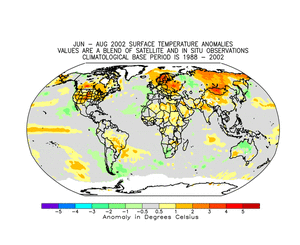
| The June-August 2002
mean temperature was above the 1988-2002 average across much of the
United States, nearly all of Europe, and from India northward
through China and eastern Russia as shown in the adjacent map of
blended satellite and in-situ data. Cooler than average
temperatures occurred across Argentina, central Russia and Japan.
The mean position of upper level ridges and troughs of low pressure
(depicted
by positive and negative 500 millibar height anomalies), are
generally reflected by areas of positive and negative temperature
anomalies at the surface, respectively. Warmer-than-average sea
surface temperatures
developed throughout the tropical Pacific during June-August,
the signature of El Niño
conditions. |
larger
image
|

larger
image
|
August temperature
anomalies calculated from the Global Historical Climatology Network
data set of land
surface stations using a 1961-1990 base period show below
average temperatures in southeast China, Japan and Korea and in the
northwest U.S. Notable warm anomalies were present across central
Europe and the eastern two-thirds of the United States. |
Temperature
June-August
- The global land and ocean surface temperature average
(June-August 2002) was the third warmest such 3-month period in the
1880-2002 record, 0.47°C (0.85°F) above the long-term mean
and 0.16°C (0.29°F) cooler than during the El Niño
year of 1998
- June-August 2002 average temperature across land areas
ranks as third warmest on record, or 0.69°C (1.24°F) above
the 1880-2001 average
|

larger
image
|
August
- For August 2002, the global average land and ocean surface
temperature was 0.41°C (0.74°F) above the 1880-2001
average, ranking as the fifth warmest August in the period of
record
- The warmest August occurred 4 years ago during the last record
warm boreal summer
- The August ocean surface temperature average was fourth warmest
on record, 0.37°C (0.67°F) above average
|

larger
image
|
- Serial monthly global surface temperature departures with
respect to a 1971-2000 mean are shown in the figure to the
right
- The recent return to record or near record temperature
departures is evident, and globally averaged surface temperatures
(land and ocean) have been warmer than the 1971-2000 average for
the last 76 consecutive months
|

larger
image
|
Precipitation
- During June-August 2002, much above average precipitation fell
across central Europe, Korea, southeast China and the U.S. Gulf
Coast
- Below average precipitation was observed across the eastern and
wester United States, the eastern Caribbean and much of India,
where monsoon rainfall was unusually light
- August
precipitation was above average across central Europe, Korea and
South Africa
- Additional regional analysis can be found on the Global Hazards
page
|
 larger
image
larger
image
|
References:
Peterson, T.C. and R.S. Vose, 1997: An Overview of the Global
Historical Climatology Network Database. Bull. Amer. Meteorol.
Soc., 78, 2837-2849.
|
 NOAA's National Centers for Environmental Information